

13th Henry Lim Lecture: Ageing and Mental Health – The CHI Study
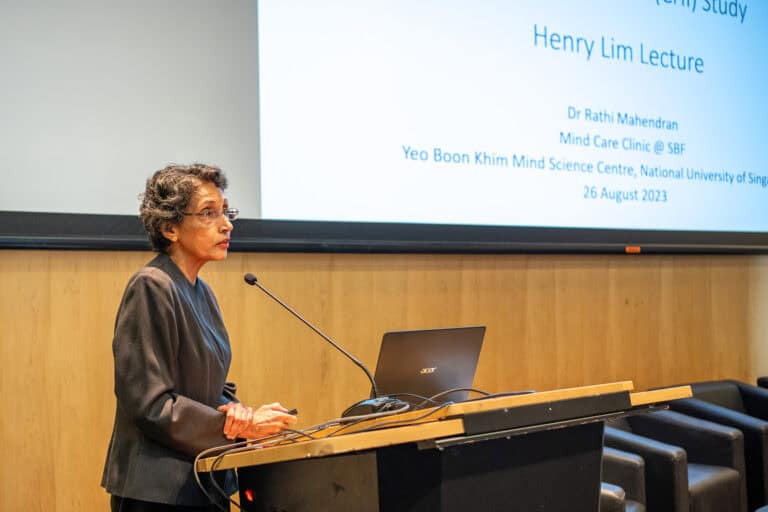
- Three psychosocial and demographic variables had significant group differences:
- (1) fewer years of education,
- (2) less perceived social support, and
- (3) higher depressive symptoms in the Mild Cognitive Impairment (MCI) group as compared to the Normal Ageing (NA) group.
- Poor oral health in the MCI group as comparted to the NA group. Those in the MCI group had higher extent and severity of periodontal disease, bleeding gums, increased inflammation. More than 10% out of MCI cases who were examined had periodontal disease.
- Those with MCI talked less and produced fewer words than cognitively intact subjects. Speech rates were lower in both subtypes of MCI, but only the lower noun rate reached significance in aMCI compared to controls.
- Poorer physical function was associated depressive and anxiety symptoms.
- Geriatric Depression Scale (GDS) was a significant predictor of Amnestic MCI (p = .000) over Normal Ageing. The correlation between GDS (odds ratio (OR) = 1.344, 95% confidence interval (CI) = 1.152–1.567] and Amnestic MCI was positive, people scoring higher on GDS were more likely to be Amnestic MCI than Normal Ageing.
For more information on the CHI study, please click here.
What is Mild Cognitive Impairment (MCI)?
While subtle changes are expected, some people experience a decline that is more than what would be considered normal. The symptoms of MCI are not as severe as dementia and most people with MCI are able to live independently.
Early signs of MCI include:
- Forgetfulness & memory lapse
- Impaired sense of direction
- Changes in personality or mood
- Language problems
- Disorientation in time
It is important to note that what is normal for one person might not be the case for another. What is considered “normal” is relative to the person’s age, education, employment status, and overall living environment.
MCI has a prevalence of 12.5% in Singapore. Gender is found to be significantly associated with MCI subtypes, with males more likely to have aMCI (amnestic MCI) and females more likely to have naMCI (non-amnestic MCI) (Liu et al., 2022).
Types of Mild Cognitive Impairment
Symptoms could be classified into 2 types: amnestic and non-amnestic MCI. That is:
Amnestic MCI Symptoms
- Getting lost in familiar places
- Forgetting recent events or appointments
- Forgetting names or conversations
Non-amnestic MCI Symptoms
- Changes in personality and behaviours
- Change in diet/eating habit
- Decline in language ability (comprehension & verbal)
- Loss of balance
- Declining attention span
Presentations
Smell Impairment and Cognitive Decline
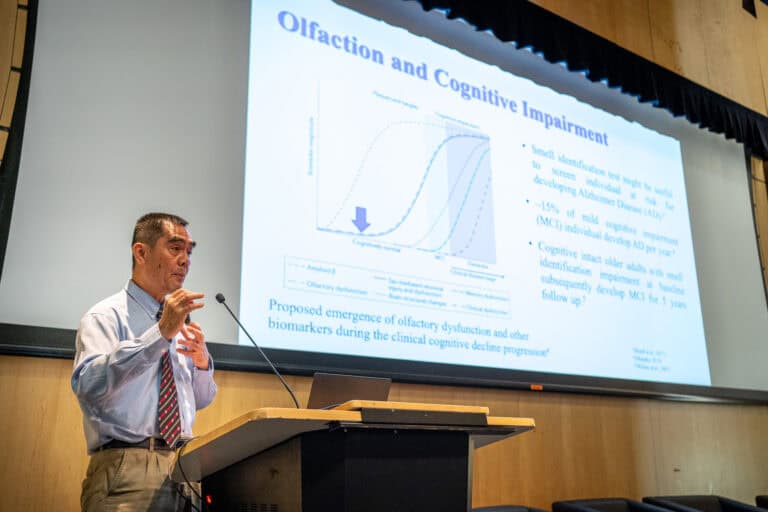
Professor Wang De Yun, a Research Professor (Tenure) and Director of Research at the Department of Otolaryngology, National University of Singapore, presented on the correlation between olfactory dysfunction and mild cognitive impairment (MCI) among older adults residing in the community. Specifically, it was highlighted that olfactory identification impairment is commonly observed as a comorbidity in older adults with amnestic MCI, suggesting its potential as an early marker for neurocognitive disorders. A smell test may be used as a screening tool, enabling early detection of olfactory impairment in the heterogeneous syndromes of MCI. Prof Wang encouraged clinicians and researchers to leverage a locally developed smell test to screen patients or research participants, facilitating the timely initiation of appropriate health interventions or inclusion in clinical trials. This approach holds promise for enhancing early detection and intervention strategies.
Find out more here.
Impact of comprehensive dietary counselling on dietary quality, mental health and cardiometabolic health in Singapore older adults
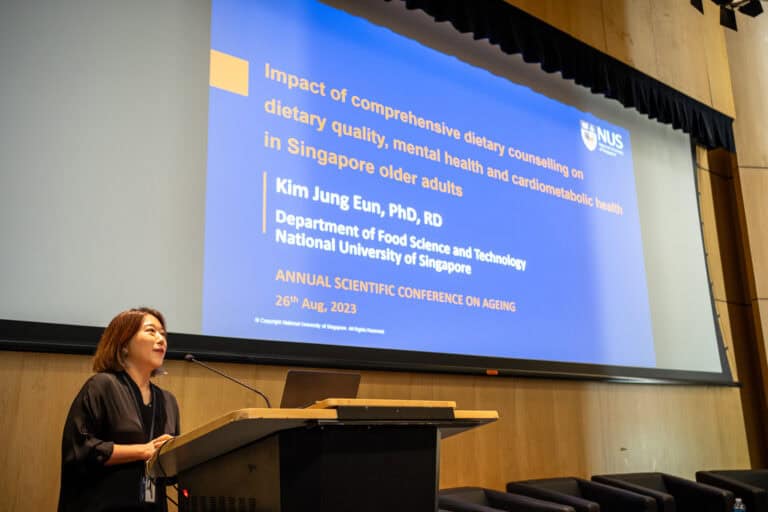
Dr Kim Jung Eun, Assistant Professor at the Department of Food Science & Technology, National University of Singapore, presented the progress of her ongoing study on the impact of dietary counselling for Singapore older adults. She mentioned that age-related factors such as increased oxidative stress, inflammation, and myocardial deterioration, as well as age-related behavioural changes such as poor nutritional choices, sedentary lifestyle, and poor sleeping cycle are linked to the development of cardiometabolic disease (CMD) and mental health disorder. Previous studies have also pointed at poor nutrition status as a risk factor. Hence, an improvement in dietary quality is a viable way to improve CMD and mental health risk.
Narrative Reminiscence intervention (NRi) for Intergenerational Family Bonding
A/Prof Wilson Tam is an Associate Professor and the Director of Research at Alice Lee Centre for Nursing Studies, NUS. At the symposium, he presented his research on NRi for Intergenerational Family Bonding which aims to examine if the intervention is feasible to implement in the local context to improve the psychological outcomes of older adults.


Image credits: Write Editions
For the pilot RCT, the team recruited older adults aged 60 or above. The team then recruited and trained their children/grandchildren, as well as some NUS Students, to act as the interviewer. Following the 6 one-on-one sessions of NRi, the research team found that subjects enjoyed the intervention and would recommend NRi to others. Furthermore, the intervention was found to positively impact intergenerational relationship, family cohesion, quality of life, subjective wellbeing, and loneliness.
The findings from this pilot was published as a chapter in a book titled “Ageing with Dignity”.
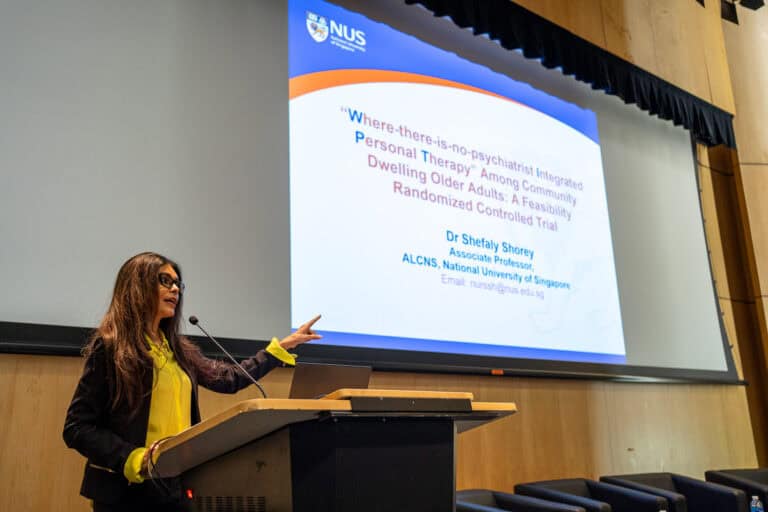
“Where-there-is-no-psychiatrist Integrated Personal Therapy” Among Community-Dwelling Older Adults: A Feasibility Randomized Controlled Trial
Support MSC’s initiatives - Promote mental resilience across all ages!
Our research takes a preventative approach to studying the mental health of the overall population. Our research focuses on those who are healthy, at risk and with subclinical mental disorders. Through the research findings, we can adopt a fresh approach to advancing mental health in our community and coping with the challenges of urban life.