
Sleep issues in the Elderly

Are sleeping pills the only solution for sleep issues?
What about melatonin?
Non-drug approaches should be the first line of defence

Prof Kua, A/Prof Tan, and Dr Yap all highlighted that in terms of helping with sleep-related issues for older persons, the recommendation is always to try non-drug methods first. These can include:
- Avoiding taking naps in the daytime
- Taking less caffeine
- Exercising
- Gardening & other nature-related activities (park prescription)
- Doing mindfulness practice to prevent your mind from wandering around
- Having a conducive habit of sleep:
- Turning down the lights
- Avoid stimulating activities just before bedtime
- Avoid the use of mobile phones before bedtime
For persistent cases, psychotherapy approaches such as cognitive behavioural therapy has shown good results in treating those with insomnia. Unfortunately, such therapies are yet to be well accepted in the Singapore older adult population. The stigma for such psychological interventions remains persistently.

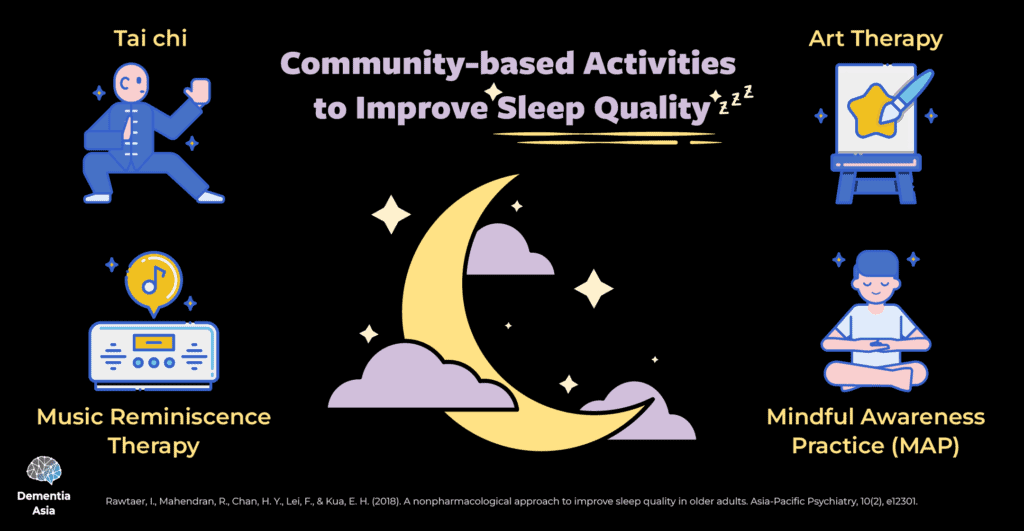
Recommended activities to improve sleep quality
- Tai chi exercise,
- Mindful Awareness Practice (MAP),
- Music reminiscence, and
- Art therapy (AT)

Quantifying sleep quality
Sleep quality was measured through the Pittsburg Sleep Quality Index (PSQI). It is a 19-item self-report measure of sleep quality over the past month. The PSQI test consists of 7 components:
- Sleep disturbances
- Sleep quality
- Sleep latency
- Sleep duration
- Sleep efficiency
- Use of sleeping medication
- Daytime dysfunction
Each component can have a score ranging from 0 to 3. The scores from each component are added together to give a global score ranging from 0 to 21. Higher scores represent greater sleep disturbance. A global PSQI score of more than 5 indicates poor sleep quality.
For analysis, change scores were calculated as the score at T1 minus the score at T0. Negative change scores thus represent improvements in sleep quality.
Mind Science Centre’s study found improvement in overall sleep quality and decrease in sleep disturbance
| Baseline (T0) Mean ± SD | 1 Year (T1) Mean ± SD | Mean Difference ± SD | |
|---|---|---|---|
| PSQI total score | 4.68 ± 3.34 | 4.45 ± 3.42 | − 0.24 ± 4.82 |
| Component Scores | |||
| Duration of sleep | 0.84 ± 0.93 | 0.85 ± 0.96 | 0.01 ± 1.3 |
| Sleep latency | 1.13 ± 1.11 | 1.06 ± 1.08 | − 0.07 ± 1.48 |
| Sleep disturbance | 1.04 ± 0.58 | 0.76 ± 0.59 | − 0.28 ± 0.85* |
| Daytime dysfunction | 0.24 ± 0.56 | 0.28 ± 0.59 | 0.04 ± 0.77 |
| Habitual sleep efficiency | 0.63 ± 0.99 | 0.69 ± 0.99 | 0.06 ± 1.39 |
| Subjective sleep quality | 0.87 ± 0.68 | 0.81 ± 0.70 | − 0.06 ± 1.02 |
| Use of sleep medication | 0.04 ± 0.29 | 0.02 ± 0.15 | − 0.02 ± 0.33 |
Looking at individual components, sleep disturbance was significantly reduced with a mean difference of (-)0.28. Sleep disturbance is a domain that includes:
- Difficulty initiating sleep
- Snoring
- Nightmares
- Nocturia (waking up at night to urinate)
- Pain
- Breathing difficulties
Associated factors: gender & attendance rates
- Males were associated with greater improvements in overall sleep quality and sleep disturbance.
- Those with a higher attendance rate also experience better improvement in their sleep disturbance score.
A point to consider: how much sleep do I need?
While this article has discussed various methods you can try to help with sleeping issues, we would suggest you take a minute to ponder on the following questions:
“What’s your definition of a good quality sleep?”
“How much sleep do you actually need?”
You might have seen in the news or other articles that doctors recommend at least 8 hours of sleep per day. But it is not that simple. Babies sleep for 16 – 17 hours a day, young adults are recommended to have 8 hours of sleep per day. What about older adults?
According to Prof Kua Ee Heok, as we grow older, we do not need such a long sleep. Most older adults can carry on normal activities with 5 – 6 hours of sleep. So, if you can naturally sleep for this recommended period, you don’t necessarily need to attempt to sleep more.
Sleeping pills and its impact on memory


Rawtaer, I., Mahendran, R., Chan, H. Y., Lei, F., & Kua, E. H. (2018). A nonpharmacological approach to improve sleep quality in older adults. Asia‐Pacific Psychiatry, 10(2), e12301.
There are currently no updates. This is the latest version available.