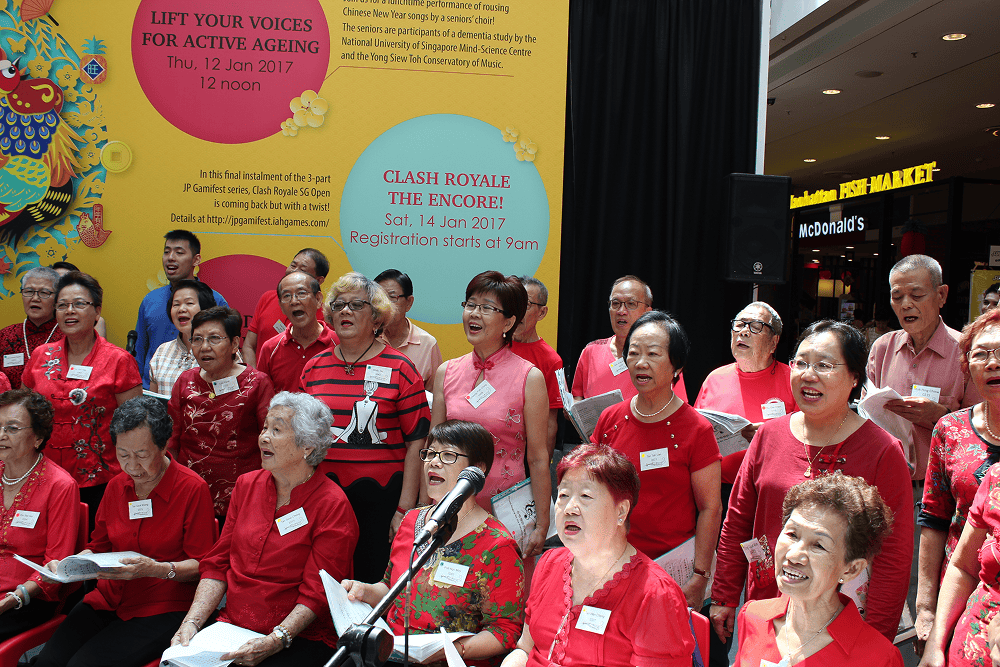

Mind Science Centre has been on a mission to study various psychosocial interventions to slow or delay cognitive decline. As part of that project, we embarked on a study to compare the health benefits of choral singing to health education in preventing dementia.
Why Choir Singing?
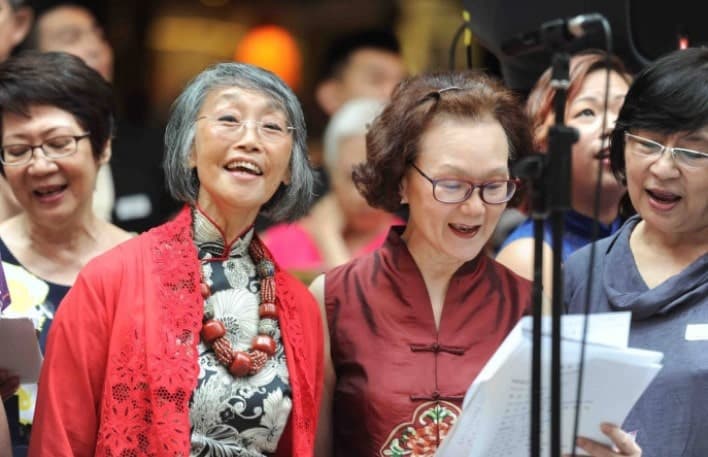
Mind Science Centre’s 2-Year Randomised Controlled Trial
- Choral Singing Intervention (CSI) or,
- Health Education Programme (HEP)
The study lasted for 2 years in which participants had to join weekly one-hour sessions of their assigned intervention (Feng et al., 2020).
Choral Singing Intervention (CSI)
Weekly sessions were held at the NUS Yong Siew Toh Conservatory of Music. 70 – 80% of the songs were those from the olden days and the other 20 – 30% comprised of new music to promote further cognitive stimulation. To provide added motivation, performances were organised every 3 – 4 months (Kua & Lim, 2022).
Health Education Programme (HEP)
In the weekly sessions, topics of high prevalence to the lives of older adults were discussed. Topics discussed include hypertension, diabetes, dementia, depression, medications, coping with grief, exercise and diet, and social support, amongst many others
This programme is delivered by a panel of healthcare professionals including clinicians, nurses, and psychologists, led by Prof Goh Lee Gan.
Study Results: Improved Cognitive Test Score & Social Connectivity
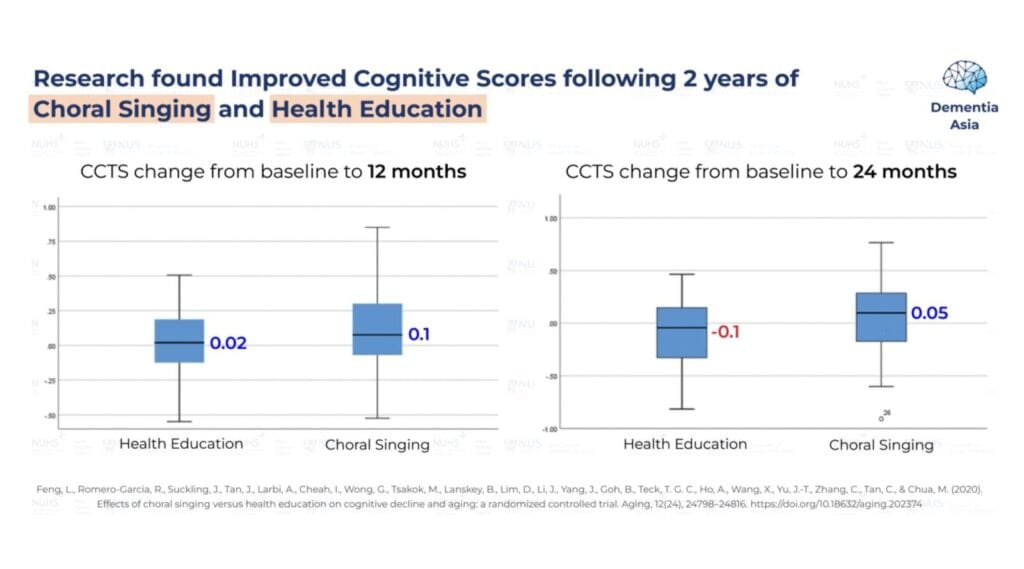
At the end of the 24-months intervention, an improved Composite Cognitive Test Score (CCTS) was found in both groups (Feng et al., 2020). The CCTS evaluates cognitive function in specific domains such as verbal memory, attention, executive function, visuospatial functioning, information processing speed, and language (Tan et al., 2018).
More Psychosocial Interventions for Dementia
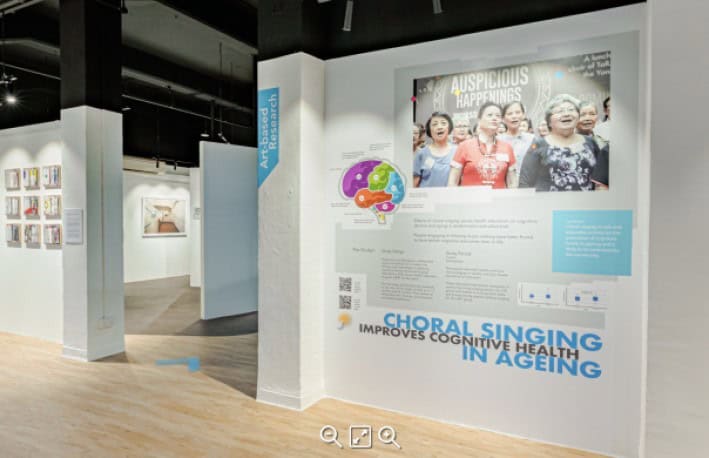
Mind Science Centre’s MAELab in an innovative space for discovery of creative and integrative interventions through art, mindfulness, and transdisciplinary research to promote mental wellness and enhance quality of mind.
National Volunteer and Philanthropy Centre. Dementia Colabs Report (2022). https://cityofgood.sg/wp-content/uploads/2022/04/Dementia-Colabs-Public-Report-5-April-2022.pdf
Tan, J., Tsakok, F. H. M., Ow, E. K., Lanskey, B., Lim, K. S. D., Goh, L. G., Tan, C.-H., Cheah, I. K.-M., Larbi, A., Foo, R., Loh, M., Wong, C. K. Y., Suckling, J., Li, J., Mahendran, R., Kua, E.-H., & Feng, L. (2018). Study Protocol for a Randomized Controlled Trial of Choral Singing Intervention to Prevent Cognitive Decline in At-Risk Older Adults Living in the Community. Frontiers in Aging Neuroscience, 10. https://doi.org/10.3389/fnagi.2018.00195
Feng, L., Romero-Garcia, R., Suckling, J., Tan, J., Larbi, A., Cheah, I., Wong, G., Tsakok, M., Lanskey, B., Lim, D., Li, J., Yang, J., Goh, B., Teck, T. G. C., Ho, A., Wang, X., Yu, J.-T., Zhang, C., Tan, C., & Chua, M. (2020). Effects of choral singing versus health education on cognitive decline and aging: a randomized controlled trial. Aging, 12(24), 24798–24816. https://doi.org/10.18632/aging.202374
Kua, E. H. & Lim, D. (2022). Choral Singing. In E. H. Kua & R. Mahendran (Eds.), Ageing with Dignity: A 10-year Study on Positive Ageing and Dementia Prevention in Singapore (pp. 33-37). Write Editions.
There are currently no updates. This is the latest version available.